
Click the opportunities below
CALL FOR EXPRESSION OF INTEREST
CALL FOR EXPRESSION OF INTEREST: Consultancy Services
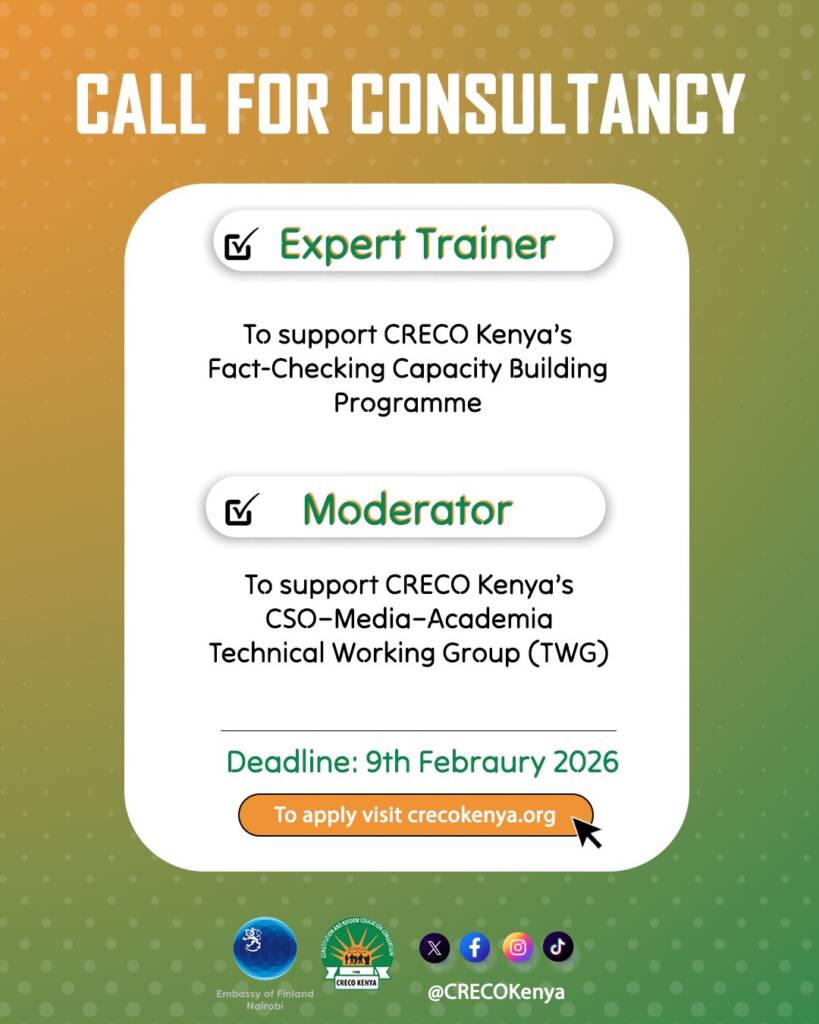
Expert Trainer – Fact-Checking Capacity Building Programme
Deadline: 9th February 2026 by 5:00 pm.
CALL FOR EXPRESSION OF INTEREST
Expert Trainer – Fact-Checking Capacity Building Programme
1.Background
CRECO Kenya is implementing a fact-checking capacity-building initiative under Output 3: Increased fact-checking capacity in media houses and colleges. The initiative seeks to strengthen the ability of civil society organizations (CSOs), media practitioners, lecturers, and bloggers to identify, verify, and responsibly communicate information in an increasingly complex digital environment.
The programme will train 100 representatives drawn from civil society, media, academia, and the blogging community using a Training of Trainers (ToT) model. Participants will be equipped with advanced fact-checking skills and trainer-level competencies, enabling them to cascade knowledge within their institutions and professional networks.
To deliver this intervention, CRECO Kenya will engage a highly skilled and experienced Expert Trainer in fact-checking to design and facilitate the training through two identical phases of virtual workshops.
2. Context
Digital platforms have transformed information production and dissemination, but they have also accelerated the spread of misinformation and disinformation. In Kenya, false and misleading information has become particularly prevalent during politically sensitive periods, civic mobilizations, and public debates on governance, social justice, and national cohesion.
CSOs, media practitioners, lecturers, and bloggers are key information intermediaries and trusted sources for the public. However, many lack advanced, practical skills and standardized methodologies for verifying digital content, including text-based claims, images, videos, and content shared through social media and messaging applications.
This activity responds to the need to strengthen fact-checking capacity among these actors, recognizing that combating mis/disinformation requires a multi-sectoral approach that focuses on those who produce, validate, interpret, and amplify information within their communities and networks.
3. Purpose of the Assignment
The purpose of this assignment is to engage an Expert Trainer to design and deliver high-quality, practical, and context-specific fact-checking training that equips 100 participants with advanced verification skills and the capacity to train others within their institutions and networks.
4. Objectives of the Assignment
The specific objectives of the Expert Trainer’s assignment are to:
- Strengthen participants’ understanding of misinformation and disinformation ecosystems and their impacts.
- Build practical competencies in fact-checking and digital verification techniques.
- Equip selected participants with trainer-level skills to cascade fact-checking knowledge.
- Promote ethical information practices and a culture of factual integrity across sectors.
6. Scope of Work
The Expert Trainer will be responsible for the following:
- a) Training Design and Preparation
- Develop a structured training curriculum aligned with the concept note and ToT approach.
- Design session plans, learning materials, practical exercises, and case studies tailored to the Kenyan context.
- Integrate adult learning methodologies and participatory approaches suitable for virtual delivery.
- b) Training Delivery
- Facilitate two identical phases of virtual training, each targeting 50 participants (total of 100 participants).
- Deliver comprehensive training covering the following thematic areas:
- Understanding misinformation and disinformation: definitions, typologies, motivations, and impacts.
- Roles of CSOs, media, academia, and bloggers in promoting information integrity.
- Fact-checking principles, ethics, and professional standards.
- Verification of text-based claims and online sources.
- Advanced image and video verification techniques.
- Fact-checking content on social media platforms and messaging apps.
- Identification of coordinated misinformation campaigns and manipulated narratives.
- Use of digital tools for fact-checking and verification.
- Responsible communication of fact-checked information to diverse audiences.
- Designing and delivering internal trainings and knowledge dissemination activities.
- c) Training of Trainers (ToT) Support
- Equip participants with skills and tools to conduct internal trainings within their institutions and networks.
- Guide participants in planning knowledge dissemination activities to ensure ripple effects and sustainability.
- Encourage peer learning and cross-sector exchange during training sessions.
- d) Coordination and Engagement
- Work closely with CRECO Kenya’s project team to align training delivery with project objectives and timelines.
- Participate in preparatory and review meetings as required.
- e) Documentation and Reporting
- Document training processes, key learning outcomes, and participant engagement.
- Submit a comprehensive training report at the end of the assignment.
7. Key Deliverables
The Expert Trainer shall deliver:
- A detailed training curriculum and session plans aligned with the ToT model.
- Facilitation of two (2) virtual training phases for a total of 100 participants.
- High-quality training materials, tools, and practical exercises for participant use and reuse.
- Support to participants in developing internal training and knowledge dissemination plans.
- A final training report highlighting:
- Training approach and content covered
- Participant engagement and learning outcomes
- Challenges and lessons learned
- Recommendations for future capacity-building initiatives
8. Expected Outputs
The expected outputs of this assignment include:
- A duly signed contract between the Expert Trainer and CRECO Kenya outlining roles, responsibilities, and deliverables.
- 100 CSO representatives, media practitioners, lecturers, and bloggers trained in advanced fact-checking techniques.
- A pool of trained trainers capable of cascading fact-checking skills within their institutions and networks.
- Strengthened collaboration between civil society, media, and academia in countering misinformation.
9. Reporting and Coordination
- The Expert Trainer will report to CRECO Kenya through the designated Project Lead.
- All deliverables will be submitted according to agreed timelines and formats.
10. Duration and Level of Effort
The assignment will be implemented over the period required to deliver two virtual training phases, including preparation, facilitation, and reporting. The exact dates will be agreed upon with CRECO Kenya.
11. Required Qualifications and Experience
The Expert Trainer should demonstrate:
- Proven experience in fact-checking, digital verification, and countering misinformation.
- Strong understanding of Kenyan and regional information ecosystems.
- Experience facilitating Training of Trainers (ToT) programmes.
- Familiarity with digital verification tools and platforms.
- Strong facilitation, communication, and adult learning skills.
- Ability to deliver engaging and practical virtual trainings.
12. Ethical Considerations
The Expert Trainer is expected to uphold high standards of professionalism, neutrality, inclusivity, and ethical conduct. All training content and engagement must promote accuracy, responsibility, and respect for human rights and democratic values.
13. Intellectual Property and Attribution
All materials developed are to be considered the property of CRECO Kenya and may not be cited without proper citations nor replicated without the permission of CRECO Kenya. This activity is made possible by the financial support from the Embassy of Finland, Nairobi. The assignment is however the sole responsibility of CRECO Kenya and no liability lies with the Finnish Government.
14. Application Submission
Interested candidates are invited to submit an application demonstrating their suitability for the assignment. The application should include:
- Technical Proposal (Max 3–4 pages)
The proposal should clearly outline:
- Understanding of the assignment and context of mis/disinformation in Kenya.
- Proposed training approach and methodology.
- Outline of key training modules and tools to be used (fact-checking, verification of images/videos, social media verification, etc.).
- Approach to ensuring participant engagement, practical learning, and knowledge transfer for cascading within institutions.
- Experience in working with multi-sectoral groups (CSOs, media, academia, digital content creators).
2. Financial Proposal
o A budget/fee quotation for delivering the assignment.
3. Curriculum Vitae (CV)
o Updated CV highlighting relevant experience and skills.
4. Sample of Previous Work
o At least one example of relevant work, such as reports.
All applications to be submitted to info@crecokenya.org CC:crecokenyamearl@gmail.com
Moderator – CSO–Media–Academia Technical Working Group (TWG)
Deadline: 9th February 2026 by 5:00 pm.
CALL FOR EXPRESSION OF INTEREST
Moderator - CSO–Media–Academia Technical Working Group (TWG)
1. Background
CRECO Kenya is implementing an initiative aimed at strengthening collaboration between civil society organizations (CSOs), media institutions, and academic actors to counter misinformation and disinformation in Kenya. This initiative contributes to Output 4: Networks between media, academia and civil society established, under which CRECO Kenya is facilitating engagements of a CSO–Media–Academia Technical Working Group (TWG).
The TWG brings together approximately 30 representatives from civil society, media institutions, academia, and relevant government bodies to serve as a structured, multi-stakeholder platform for sustained dialogue, joint analysis, and coordinated responses to mis/disinformation. Through 2 physical meetings and 5 webinars, the TWG examines emerging misinformation trends, documents best practices, identifies policy and legislative gaps, and supports collective strategy development.
To ensure effective facilitation, coherence of dialogue, and actionable outcomes, CRECO Kenya will engage a highly skilled Moderator to guide TWG meetings and webinars throughout the project period.
2.Context
Misinformation and disinformation are complex, cross-cutting challenges that undermine democratic participation, public trust, social cohesion, and institutional legitimacy. In Kenya, mis/disinformation manifests across political processes, civic engagement, social movements, and digital platforms, often exploiting institutional silos between media, civil society, and academia. While media institutions offer reach and agenda-setting power, civil society brings community-level insights and advocacy experience, and academia contributes research, theory, and evidence. However, limited coordination among these sectors weakens collective responses to information disorder.
The CSO–Media–Academia TWG responds to this gap by creating a sustained, institutionalised coordination space where diverse actors can engage critically, share learning, and co-develop solutions. The Moderator plays a central role in ensuring this space remains inclusive, evidence-informed, strategic, and oriented toward concrete institutional and policy-relevant outcomes.
3.Purpose of the Assignment
The purpose of this assignment is to provide professional, neutral, and expert moderation of the CSO–Media–Academia Technical Working Group meetings and webinars, and to synthesise TWG deliberations into a Policy Recommendation Paper that can inform institutional and policy responses to misinformation and information integrity in Kenya.
4.Objectives of the Moderation Role
The specific objectives of the Moderator are to:
- Facilitate structured, inclusive, and evidence-informed dialogue among CSO, media, and academic actors on mis/disinformation and information integrity.
- Support critical examination of mis/disinformation trends, institutional responses, and best practices across sectors.
- Guide identification of strategic, policy, and legislative recommendations emerging from TWG deliberations.
- Strengthen trust, collaboration, and shared understanding among TWG members.
- Ensure coherence and continuity between TWG engagements and the Media–CSO–Academia Strategy Conference.
5. Policy Output and Purpose
An integral output of the CSO–Media–Academia Technical Working Group is the development of a Policy Recommendation Paper.
The Policy Recommendation Paper shall:
- Be derived from, and grounded in, deliberations, insights, and consensus emerging from TWG meetings and webinars.
- Consolidate cross-sector perspectives from civil society, media, academia, and relevant government institutions.
- Examine misinformation and disinformation trends, institutional responses, coordination gaps, and best practices.
- Present clear, practical, and actionable policy and institutional recommendations targeted at relevant government departments, regulatory bodies, media institutions, academic institutions, and civil society coordination platforms.
The Policy Recommendation Paper will be advisory in nature. It is not a legislative draft, statutory instrument, or lobbying document. Its purpose is to inform institutional practice, coordination mechanisms, and policy engagement related to misinformation and information integrity in Kenya.
6.Scope of Work
The Moderator’s scope of work includes, but is not limited to, the following:
- a) Facilitation of Physical TWG Meetings
- Moderate two (2) physical quarterly TWG meetings in line with agreed objectives and agendas.
- Ensure balanced participation across sectors and manage group dynamics professionally.
- Encourage dialogue, synthesis, and consensus-building rather than parallel presentations.
- Provide real-time synthesis of discussions and clarification of emerging themes and action points.
- b) Facilitation of Webinars
- Moderate at least five (5) structured thematic webinars focusing on:
- Effective CSO–Media–Academia partnerships.
- Strengthening and leveraging existing networks and synergies.
- Institutionalising collaboration mechanisms.
- Responding to emerging digital mis/disinformation trends.
- Ensure clarity, inclusivity, and focused engagement in virtual settings.
- c) Technical and Strategic Input
- Provide expert input, where appropriate, on mis/disinformation, media policy, digital rights, fact-checking, governance, or multi-stakeholder collaboration.
- Support the framing of guiding questions, discussion themes, and reflection points.
- Assist in translating discussions into strategic insights and policy-relevant recommendations.
- d) Documentation and Follow-up Support
- Work closely with CRECO’s technical team to validate key discussion points, conclusions, and action items.
- Support alignment of TWG outputs with inputs required for the Media–CSO–Academia Strategy Conference and policy paper.
e) Development of the Policy Recommendation Paper
- Synthesise discussions, insights, and agreed positions emerging from TWG engagements into a single, coherent Policy Recommendation Paper.
- Structure the paper in a policy-oriented format suitable for uptake by relevant institutions and departments.
- Ensure the paper reflects collective TWG perspectives rather than individual opinions.
- Support validation of the draft Policy Recommendation Paper by TWG members prior to finalisation.
- Work closely with CRECO Kenya to ensure alignment with project objectives and timelines.
7.Key Deliverables
During the period of engagement, the Moderator is expected to:
- Participate in preparatory coordination meetings with CRECO Kenya.
- Successfully facilitate:
- Two (2) physical TWG meetings.
- Five (5) TWG webinars.
- Provide clear verbal synthesis and validation of key insights and action points during each engagement.
- Contribute thematic and strategic inputs informing:
- TWG strategic direction.
- Agenda-setting for the Media–CSO–Academia Strategy Conference.
- A consolidated and validated Policy Recommendation Paper, grounded in TWG deliberations and providing actionable recommendations to relevant institutions and departments.
8.Expected Outputs
The expected outputs from this assignment include:
- A duly signed contract between the Moderator and CRECO Kenya outlining roles, responsibilities, and deliverables.
- High-quality, inclusive TWG engagements resulting in clear cross-sector learning and consensus.
- A validated Policy Recommendation Paper serving as a reference document for institutional and policy engagement on misinformation and information integrity.
- Strengthened coordination and collaboration between media, academia, and civil society actors.
9.Reporting and Coordination
- The Moderator will report directly to CRECO Kenya through the designated Project Lead.
- The Moderator shall remain accountable for both effective facilitation and the quality, clarity, and policy relevance of the Policy Recommendation Paper.
- All engagements shall align with CRECO Kenya’s values, timelines, and project objectives.
10.Duration and Level of Effort
The assignment will run from January to July 2026, aligned with the TWG calendar of activities.
The level of effort will be intermittent and based on scheduled meetings, webinars, and preparatory engagements.
11. Required Qualifications and Experience
The Moderator should demonstrate:
- Proven experience facilitating multi-stakeholder dialogues involving CSOs, media, academia, and/or government.
- Expertise in one or more of the following areas:
- Misinformation and disinformation
- Media policy and regulation
- Digital rights and freedom of expression
- Journalism, fact-checking, or media development
- Governance, democracy, or civic engagement
- Strong facilitation, synthesis, and communication skills.
- Professional neutrality and ability to manage diverse perspectives.
12. Ethical Considerations
The Moderator is expected to uphold high standards of integrity, confidentiality, inclusivity, and professionalism. All engagements must promote respectful dialogue, evidence-based discussion, and adherence to democratic values and human rights.
13. Intellectual Property and Attribution
All materials developed are to be considered the property of CRECO Kenya and may not be cited without proper citations nor replicated without the permission of CRECO Kenya. This activity is made possible by the financial support from the Embassy of Finland, Nairobi. The assignment is however the sole responsibility of CRECO Kenya and no liability lies with the Finnish Government.
14. Application Submission
Interested candidates are invited to submit an application demonstrating their suitability to moderate the CSO–Media–Academia Technical Working Group (TWG). The application should include:
1. Technical Proposal (Max 3–4 pages)
The proposal should clearly describe:
• Understanding of mis/disinformation dynamics in Kenya and the need for cross-sector collaboration.
• Approach to moderating multi-stakeholder dialogues involving civil society, media, academia, and policy actors.
• Methodology for facilitating constructive discussions, managing diverse perspectives, and ensuring inclusive participation.
• Approach to synthesizing deliberations into clear outputs, particularly policy-oriented recommendations.
• Strategy for supporting the development of a policy paper emerging from TWG discussions.
• Experience in facilitating policy dialogues, technical working groups, or similar platforms.
2. Financial Proposal
o A fee quotation covering professional facilitation and moderation services for: two physical quarterly meetings, at least five webinars and support to the development and validation of the TWG policy paper.
3. Curriculum Vitae (CV)
An updated CV highlighting relevant and proven experience and skills.
4. Sample of Previous Work
At least one relevant sample such as: a policy paper or analytical brief authored or co-authored, a meeting report or synthesis document from a moderated forum or documentation from previous facilitation of policy or multi-stakeholder processes
All applications to be submitted to info@crecokenya.org CC:crecokenyamearl@gmail.com
All applications to be submitted to info@crecokenya.org CC:crecokenyamearl@gmail.com